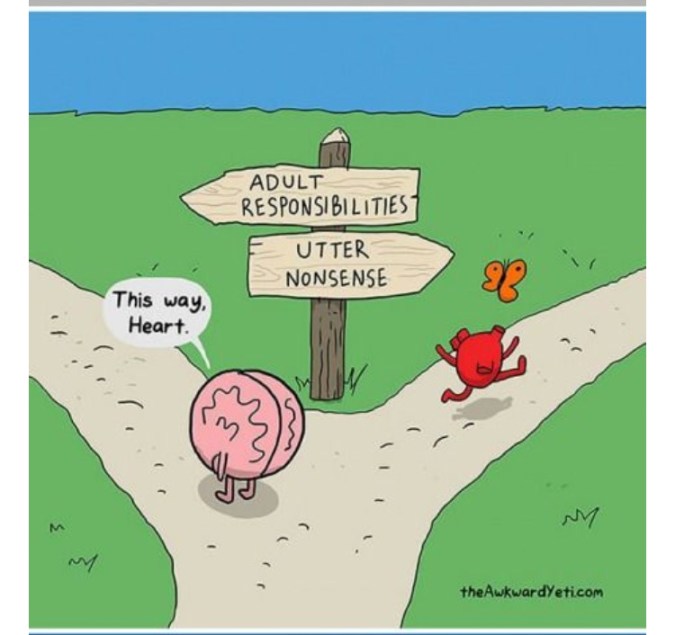
I’ve had some ‘head versus heart’ stuff going on recently. A conversation that I almost don’t feel quite part of yet caught in the middle of. The quiet, unassuming wisdom of my heart versus the forthright and determined tantrum of my head. Presently I feel like a back seat driver, passively mediating a conversation between the two and allowing each their full expression before I cast the final call.
My heart is the passively assertive director nudging its way into my world. I am aware that it will take no prisoners should it not be heard. My head however will scream and shout and tell the internal world that it’s ‘this way or the highway’.
At the moment I’m not sure how to mediate a resolution between the two but I do know that they each have viable requirements. I trust my heart, it’s voice, it’s wisdom and sincerity in that it always knows what right for me. My head is a little less reliable but always comes up with a good argument for the defence! It’s just that right now I’m unsure of the compromise to be made and neither want to back down.
So I’m bringing my recently lapsed meditation practise back in to the game with a disciplined attendance. I am hoping that amongst the quiet yet assertive echoes of my heart and the dogmatic and formidable force of my head, I may just come up with a solution!
Often when I am facing a minor indecision or a need to become clear on something, I sit quiet, push the issue to one side and focus on my body. I get centred, I concentrate on my breathing and I become mindful. I stay with this for about 10 minutes. When I return to my issue, 8 times out of 10 the answer is clear.
I’ve been teaching and guiding people through the practise of meditation and deep relaxation for a few years now which prompted my development into Hypnotherapy.
One thing people often say in the beginning is ‘I don’t know where to start’, ‘It’s so hard’ or ‘I just can’t do it!’. If you’ve been busy or had a stimulating day, then you’re going to be hard pushed to sit down at the end of it and physically or mentally just ‘let go’. You’ve got to come off the boil – simmer down, collect your thoughts then centre and focus. That takes time, commitment and lots of discipline!
The greatest pitfall in establishing an effective meditation practice, especially in the early stages is not understanding or appreciating that it is a DISCIPLINE.
Discipline as defined by the Oxford dictionary – ‘training that produces orderliness, obedience, self control …’
That just about sums it up!
It’s often thought that sitting quietly, with your eyes closed for 10 – 30 minutes surely takes little if any effort; physically you’d be correct in that assumption. The fact is, your meditation time is a mental, emotional and spiritual ‘thing’. When we sit quietly, close our eyes and focus on our breath you can bet everything else but that will happen; in the early days that is.
To quieten the mind or move away from all our brain activity and mental stimulation whilst sitting quietly with your eyes closed can be like taking kids out of a party then immediately asking them to sit quietly with their arms and legs crossed – honestly!
It can feel, at times like psychological warfare in your head whilst frustration, agitation and restlessness hammer away at your limbs. That discomfort is why meditation becomes a lost cause for many.
Brain wave activity needs to slow down and thoughts / mental stimulation to settle – I call this brain processing time!
We also have to factor in those emotions or feelings we’ve been trying to avoid. This is often the ‘just getting on with it’ scenario I spoke about last week in my Facebook Video Blog . These feelings or emotions can sit quietly or not so quietly biding their time until they’ve got your attention i.e. bed or meditation time and then ‘POW’ the freight train comes in carrying that hefty load of baggage.
This is often when people relieve themselves of their ‘commitment’ telling themselves ‘I just can’t do it, my mind won’t stay still!’ Actually your mind is doing a whole host of gymnastics to avoid settling down and getting into those feelings – that’s resistance.
So perhaps this is a Catch 22 scenario you may ask? NO … it is not!
It is just that you need strength, commitment and discipline to work through these times, simple … or not, as is often the case!
The point is however …
If you want a taste of some inner peace
release feelings of overload & confusion
get mental clarity & physical relaxation
be more mindful of those happy moments
understand yourself better
make ‘well informed’ decisions
begin to fulfil your unique potential ….
Then … all the ‘stuff’ has to be allowed to surface and be processed so it stops clogging up the system and potentially crashing the hard drive!
It will shift and you will learn a lot in the process if you listen 😉
Meditation and its various guises come under many different labels and banners. The whys and wherefores of Buddhist meditation, Zen meditation, Transcendental … Mindfulness, Guided CD’s etc can create a minefield for those wishing to establish and gain the plethora of personal wealth which comes from establishing a successful practice.
It is often stated that Prayer is talking to God and Meditation is listening – beliefs aside, you are learning to listen, learning to hear the all-knowing, loving, wise and compassionate part of your higher self. it is the part that will ALWAYS be there for you, always gives you good advice and will always know just what is best for you in any given time. Surely that’s worth investing in?
It does however only come in stillness and focused attention or more specifically, that you are likely to ‘hear’ it then.
Like the development of any new skill whether it is an exercise class, learning to play an instrument or a language class, discipline and commitment are essential ingredients in the recipe for success.
I tell you this because it matters. There is little point in giving you information on how to create a successful practice and potentially change your life if I do not enlighten you to the potential pitfalls first and ultimately a hefty dose of human reality! It can take a lifetime or more to touch on profound peace but many more to become enlightened. Starting with your eyes wide open can only be a good thing.
Through the development of my own regular practice and the teaching of students, I understand the enigmatic status that often comes with meditation. I have encountered many books on the subject over the years and every bookstore has a wealth of information on mindfulness. I also know how lengthy and intense many of them are. There are volumes of information which we are required to wade through in order to get some idea of where to start.

There are books out there with 25 chapters and more on mindfulness. If you’d like to gain comprehensive spiritual or psychological understanding of what it is you’re doing and how to live a mindful life, then they are worth reading. If you really want to deepen your practice and develop yourself at a different level or you are an aspiring practitioner of Buddhism, then read them.The everyday person however does not.
You can get the benefits of meditation without the reading and study of volumous texts. Too much information just confuses an already busy mind. Sure there are words of wisdom, anecdotes to spiritual growth, but if this isn’t what you want then don’t tie yourself up in knots about it.
Students & Clients ask me to recommend an easy, step by step approach that will help them build an effective practice so they can take its benefits into everyday life.
7 STEPS is just that – a step by step approach. You can progress with each step, each day if that works for you or spend a few days or a week working on each step at a time.
Mediation isn’t complicated but there is no ‘magic pill’ to get you there. It requires self-control, it also develops focus and awareness yet more importantly it helps you to hear the beat of your own drum.
It is a bit of a chicken and egg situation in that you have to put small amounts in of what you want to get out, only in greater and more beneficial amounts! Some days will be harder or more challenging than others for many reasons, accept it. The key is to see it for what it is and not to get frustrated by it – it happens, acknowledge it and accept it.
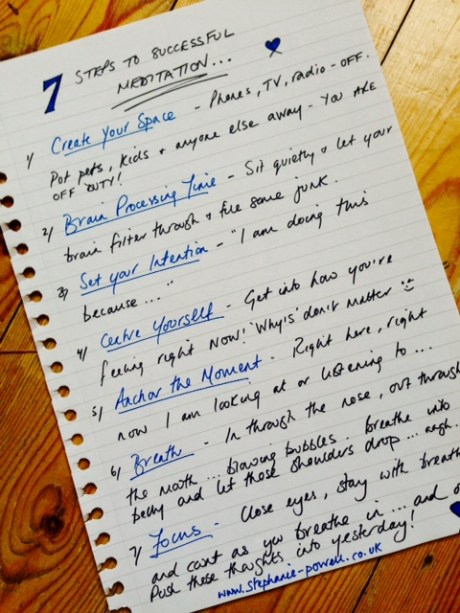
So here are your 7 STEPS to Successful Meditation ™ – easy to read & easy to follow :
1. CREATE YOUR SPACE
Phones, TV, radio off and out of hearing range. Pets put away somewhere else … be alone if possible or notably out of action 😉 A regular spot, clean and tidy will help. Incense / candles can become good mental triggers for but not necessary. Music optional.
2. BRAIN PROCESSING TIME
5 minutes spent sitting quietly and comfortable with eyes open. Brain wave activity is slowing down and thoughts beginning to settle. Your head is filtering and processing. Just be quietly in the space.
3. SET YOUR INTENTION
The WHAT & the WHY you are doing this. Affirm each time before you begin e.g ‘This practise is helping me live a stress free life’ … ‘My practise helps me find clarity in my decision making’ … ‘I am developing my spiritual practice.’ …
4. CENTRE YOURSELF
Bring your awareness to your body. Notice how it feels, how you feel. Just notice, don’t think or analyse … just do.
5. ANCHOR THE MOMENT
Soften gaze and gently focus on something – candle, clock ticking, incense smoke … Become completely present with whatever you’re engaged with.
6. BREATH
Start to follow your breath – allowing it to settle as it may be a little jumpy, go with it. Try to breathe in through the nose and out through mouth like blowing bubbles until breath flows smoothly. Breathe into belly button like blowing up a balloon, shoulders & chest down & relaxed.
7. FOCUS
Close your eyes … Stay with the flow of your breath. Count as you breathe in and count as you breathe out. If thoughts come imagine you pushing them away to one side in your head. Try to lengthen the breaths in / out by counting to a higher number. DO NOT FORCE OR STRAIN THE BREATH.Focus and relax …
Continue for 5 – 10 mins to start with and build from there up to 30 – 40 mins if you wish.
These steps are for beginners or those wishing to re-establish a practise. Following these steps makes it easier for your brain, mind and body to get into routine and surrender to the process a little more.
Start with what feels comfortable. Steps 1 – 7 can be done easily in 15 mins with 5 of that brain processing time. You can spend a whole week developing steps 1 & 2 if that works for you and a week for each step thereafter.
Be patient with yourself in the beginning and understand that you’re learning, developing and creating a new tool – one that can AND hopefully will, Change Your Life. ♥
Courses and workshops are run throughout the year. Please see ‘News, Courses & Events’ page @ www.stephanie-powell.co.uk
Please let me know how y’all get on, what comes up and what gets you down.
With love & calm thoughts …
Steph xx
 The Hummingbird Diaries